 Printhawk
The best paper for art prints: how to choose for your artwork
Updated
For most art prints, choose a heavy, matt fine art paper around 300 gsm. Smooth cotton (such as Hahnemühle Photo Rag) suits illustration, watercolour and detailed work; a textured paper (such as German Etching) suits paintings. For photography, consider a lustre or baryta finish. Always test with a sample.
“Best” depends on three things: the artwork, how it will be displayed, and what your buyer expects to pay. A paper that flatters an oil painting can blur a fine-line illustration, and a premium cotton paper can price a small print out of its market. Start with the artwork.
Best paper by type of artwork
| Artwork | Paper type | Examples (Hahnemühle) | Why |
|---|---|---|---|
| Oil and acrylic paintings | Textured matt | German Etching 310 gsm, Museum Etching 350 gsm | Texture echoes canvas and brushwork |
| Watercolour and gouache | Watercolour-textured or soft felt matt | William Turner 310 gsm, Photo Rag 308 gsm | Looks and feels like the original paper |
| Ink, line art, illustration | Smooth matt | Photo Rag Ultra Smooth 305 gsm, Photo Rag 308 gsm | Keeps fine lines sharp |
| Digital art, bold colour | Smooth matt or pearl | Photo Rag Bright White 310 gsm, Photo Rag Pearl 320 gsm | Bright base, saturated colour |
| Colour photography | Pearl, satin or baryta | Photo Rag Baryta 315 gsm, FineArt Baryta 325 gsm | Deep blacks and contrast |
| Black and white photography | Matt cotton or baryta | Photo Rag 308 gsm, Photo Rag Matt Baryta 308 gsm | Neutral tones, rich blacks |
| Warm, earthy or vintage work | Natural white, no brighteners | Bamboo 290 gsm, Museum Etching 350 gsm | Warm paper tone flatters warm palettes |
Weights, fibres and finishes from Hahnemühle's product pages and data sheets, read 27 November 2026. The full comparison is in fine art paper.
Four questions that settle it
- Texture or detail? Texture adds depth to paintings but softens fine lines. If in doubt, choose smooth.
- Warm or bright white? Your paper's white becomes every highlight. Bright white papers often contain optical brighteners; natural whites usually do not. Hahnemühle lists OBA content on each data sheet.
- Glass or no glass? Behind glass, matt and lustre avoid double reflections; unframed, glossy shows every fingerprint. See matte vs glossy.
- What price point? Branded cotton papers cost more to print. That suits signed, limited editions; open editions at lower prices may sell better on a house paper. See how to price art prints.
The papers you can order through Prodigi
If you sell through a print-on-demand lab, you choose from its list, not the maker's. Prodigi's paper prints on 27 November 2026, from its product pages:
| Prodigi paper | Weight | Surface and finish | White | Good for |
|---|---|---|---|---|
| Hahnemühle German Etching | 310 gsm | Textured, velvet matte | Warm natural white | Paintings, limited editions |
| Hahnemühle Photo Rag | 308 gsm | Soft felt, matte, 100% cotton | Natural white | Photo prints with a smooth, refined finish |
| Cold Press Watercolour Paper | 315 gsm | High texture, matte, 100% cotton rag | Mid natural white | Portraits, tactile illustration |
| Smooth Art Paper | 240 gsm | Smooth, fine grain, matte | Bright white | Contemporary illustration, photography |
| Enhanced Matte Art | 200 gsm | Smooth, matte | Natural white | Bestselling all-rounder, graphics |
| Lustre Photo Paper | 240 gsm | Pearl-like texture, satin | Bright white | Portraits, landscapes |
Prodigi lists all six with Giclée as the printing method and publishes an ICC profile for each. The “good for” column paraphrases Prodigi's own descriptions. It also offers a Budget Art Paper for volume work.
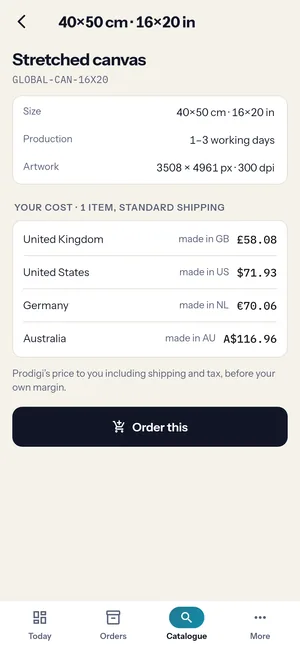
Once you have picked a paper, check each size you plan to sell: Printhawk's catalogue shows the artwork pixels each size needs and what it costs to make and ship to the UK, US, Germany and Australia, so you can see which sizes your file and your margins support. For sizes, see art print sizes.
Test before you commit
Order a sample on every paper you are considering, print the same image on each, and look at them in the room light your buyers will have. Pay attention to the darkest areas, skin tones and large flat colours. Then photograph the winner for your listings, so buyers see the real surface.
Questions
What paper is best for art prints?
For most artists, a heavy matt fine art paper around 300 gsm: a smooth one such as Hahnemühle Photo Rag for illustration, watercolour and photography, or a textured one such as Hahnemühle German Etching for paintings. Choose a glossy baryta paper for photographs that need deep blacks.
What gsm is best for art prints?
Most fine art papers used for wall prints are around 285 to 350 gsm. Lighter papers around 200 to 240 gsm are common for more affordable art prints and posters.
Is matte or glossy better for art prints?
Matte for most art reproductions: it looks like the original medium and has no glare. Glossy or pearl suits photography and very saturated digital art.
What paper do professional artists print on?
Many sell giclée prints on branded cotton or alpha-cellulose fine art papers such as Hahnemühle Photo Rag and German Etching, because buyers recognise the names. Others use a lab's house paper to keep prices lower.
Should I offer more than one paper?
Usually not at first. One paper per collection keeps listings simple and makes your prints consistent. Add a premium paper later if buyers ask for it.
Sources
- Hahnemühle product pages and data sheets: German Etching, Museum Etching, William Turner, Photo Rag, Photo Rag Ultra Smooth, Photo Rag Bright White, Photo Rag Pearl, Photo Rag Baryta, FineArt Baryta, Photo Rag Matt Baryta, Bamboo (hahnemuehle.com), read 27 November 2026.
- Prodigi product pages: Hahnemühle German Etching, Hahnemühle Photo Rag, Cold Press Watercolour Paper, Smooth Art Paper, Enhanced Matte Art, Lustre Photo Paper, Budget Art Paper (prodigi.com/products/prints-and-posters), read 27 November 2026.